Call Us At 604-399-8066

How Cisco AI-RRM Automatically Optimizes Wi-Fi Networks (Complete Guide)
Introduction
Modern Wi-Fi networks are becoming more complex every year. With more users, devices, and wireless applications, maintaining stable wireless performance has become a major challenge for network administrators. Traditional wireless tuning methods often require manual adjustments and continuous monitoring.
To solve this challenge, Cisco Systems introduced an advanced technology called Cisco AI‑RRM, which uses Artificial Intelligence to automatically optimize wireless network performance.
In this article, we will explore what Cisco AI-RRM is, how it works, and how it improves Wi-Fi performance in real-world environments.
What is Cisco AI-RRM?
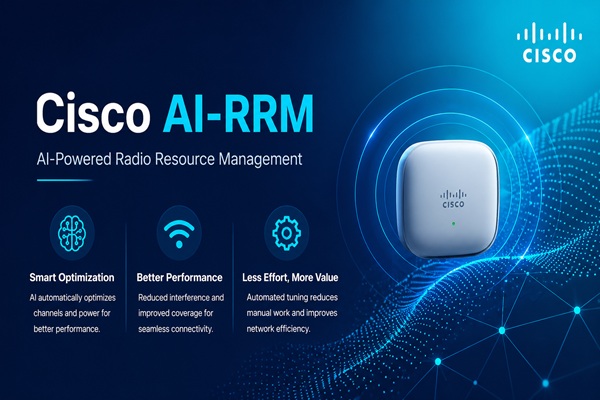
Cisco AI-RRM stands for Artificial Intelligence Radio Resource Management.
It is an advanced feature designed to automatically manage wireless radio settings such as:
- Wi-Fi channels
- Transmission power
- RF interference
- Coverage optimization
- Client performance
Traditional RRM systems use predefined rules, but AI-RRM uses machine learning and historical data to make smarter decisions.
This allows networks to adapt dynamically to changing wireless conditions without manual intervention.
Why Traditional Wi-Fi Optimization Is Difficult?
Before AI-driven networking, optimizing Wi-Fi networks required manual adjustments.
Network administrators typically had to:
- Scan wireless channels
- Identify interference sources
- Adjust transmit power
- Reconfigure access points
- Test performance repeatedly
This process could take hours or even days, especially in large environments.
Common problems included:
- Channel interference
- Coverage gaps
- Overloaded access points
- Poor roaming performance
These issues directly affected user experience and productivity.
How Cisco AI-RRM Works?
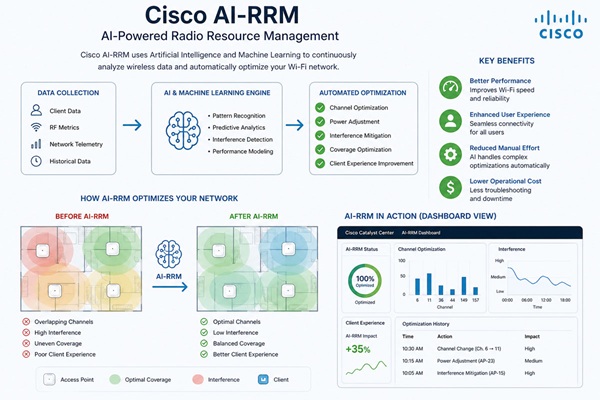
Cisco AI-RRM continuously collects wireless performance data from access points and clients.
It analyzes:
- Signal strength (RSSI)
- Noise levels
- Channel utilization
- Client density
- Interference patterns
Using AI algorithms, the system identifies optimization opportunities and applies improvements automatically.
Key actions performed by AI-RRM include:
Automatic Channel Selection
AI-RRM dynamically selects the best wireless channel based on real-time interference analysis.
If interference increases on one channel, the system automatically moves the access point to a cleaner channel.
Dynamic Power Adjustment
Transmit power is automatically adjusted to:
- Reduce interference
- Improve coverage
- Optimize roaming performance
This ensures devices connect to the best access point available.
Continuous Learning
Unlike traditional systems, AI-RRM learns from past network behavior.
Over time, it becomes more accurate and efficient at predicting wireless performance issues before they impact users.
Real-World Example of Cisco AI-RRM
Let’s look at a realistic business scenario.
Office Environment Example
Network Setup:
- 18 Cisco Access Points
- 120 employees
- 3 office floors
- Multiple meeting rooms
Problem:
Users reported slow Wi-Fi performance during peak hours.
Common complaints included:
- Video calls freezing
- Slow file uploads
- Frequent Wi-Fi drops
Without AI-RRM
The IT administrator would need to:
- Run wireless surveys
- Check channel conflicts
- Manually adjust power levels
- Test performance multiple times
This process could take several days.
With Cisco AI-RRM
The system automatically detected:
- High channel congestion
- Overlapping signals
- Uneven client distribution
AI-RRM responded by:
- Changing congested channels
- Adjusting transmit power
- Redistributing wireless coverage
Result:
- Faster Wi-Fi speeds
- Improved roaming
- Reduced connection drops
- Higher user satisfaction
This type of automated optimization significantly reduces operational workload.
Key Benefits of Cisco AI-RRM
Organizations using AI-RRM experience measurable improvements in wireless performance.
- Reduced Interference
AI-based channel optimization minimizes signal conflicts between access points.
This improves overall wireless stability.
Better Coverage
Automatic power adjustments eliminate coverage gaps and overlapping signals.
Users experience stronger connections across the building.
- Faster Troubleshooting
AI systems detect problems early and fix them before users notice.
This reduces support tickets and downtime.
- Improved Roaming
Devices switch between access points smoothly without connection drops.
This is especially important in:
- Hospitals
- Warehouses
- Large office environments
- Lower Operational Costs
Automation reduces the need for manual network tuning.
IT teams can focus on strategic tasks instead of repetitive adjustments.
Where Cisco AI-RRM Is Commonly Used?
AI-RRM is widely deployed in environments with large wireless networks.
Typical use cases include:
– Corporate Offices
Managing hundreds of employees and devices across multiple floors.
– Hospitals
Supporting mission-critical applications such as patient monitoring systems.
– Schools and Universities
Handling thousands of student devices simultaneously.
– Warehouses and Industrial Sites
Ensuring reliable wireless connectivity for scanners and IoT devices.
AI-RRM vs Traditional RRM
Understanding the difference helps highlight the value of AI networking.
Traditional RRM
- Rule-based optimization
- Limited adaptability
- Slower response time
- Requires manual tuning
AI-RRM
- Machine learning-based
- Predictive optimization
- Continuous improvement
- Fully automated adjustments
AI-driven networking represents a major evolution in wireless technology.
Best Practices When Using Cisco AI-RRM
To get the best results, organizations should follow recommended deployment practices.
Use Proper Access Point Placement
Physical placement still plays a major role in wireless performance.
Avoid:
- Metal obstructions
- Dense walls
- Ceiling interference
Monitor Network Analytics
Use Cisco network dashboards to monitor:
- Client performance
- Channel usage
- RF health
AI works best when supported by good visibility tools.
Perform Periodic Wireless Surveys
Even with AI automation, periodic validation ensures optimal performance.
This helps verify environmental changes.
The Future of AI in Wireless Networking
AI-driven networking technologies like Cisco AI-RRM represent the future of wireless infrastructure.
Future improvements may include:
- Fully self-healing networks
- Predictive failure detection
- Autonomous wireless optimization
- AI-based security integration
As wireless networks continue to grow, AI will become essential for maintaining performance and reliability.
Conclusion
Cisco AI-RRM is transforming the way wireless networks are managed.
By automating channel selection, power control, and interference mitigation, it significantly improves network performance while reducing manual workload.
Organizations deploying AI-driven wireless solutions benefit from:
- More stable connections
- Better user experience
- Faster troubleshooting
- Lower operational costs
As AI technologies continue to evolve, tools like Cisco AI-RRM will become a standard component of modern wireless networks.
Recent Blogs
- The Future of Backup Infrastructure: AI, Autonomous Recovery, and the Evolution of Cyber Resilience

- The Future of Networking: How Automation and AI Are Transforming Modern Infrastructure

- How Cisco AI-RRM Automatically Optimizes Wi-Fi Networks (Complete Guide)

- AWS vs Azure vs GCP – A Practical Comparison of the Top Cloud Providers





FAQ:
Q1: What is Cisco AI-RRM?
A1: Cisco AI-RRM is an AI-powered feature within wireless networking solutions from Cisco that automatically manages radio resources (Wi-Fi spectrum). It continuously optimizes channel selection, transmit power, and RF parameters to improve overall wireless performance.
Q2: What problem does AI-RRM solve?
A2: Traditional Wi-Fi networks often suffer from interference, congestion, and inconsistent performance due to static or manual configurations. AI-RRM helps reduce:
- Co-channel and adjacent-channel interference
- Network congestion
- Fluctuating wireless performance
Q3: Does AI-RRM require manual configuration?
A3: In most cases, no. AI-RRM works autonomously by continuously analyzing the RF environment. However, network administrators can still apply policies or constraints when needed for specific business requirements.
Q4: What is the main benefit of AI-RRM?
A4: The key benefit is real-time, adaptive optimization of the wireless network. Instead of relying on static rules, the system dynamically adjusts based on live network conditions.
Q5: Where is AI-RRM most useful?
A5: AI-RRM provides the most value in high-density and mission-critical environments such as:
- Enterprises
- Hospitals
- Universities
- Large public venues and campuses
Q6: How does AI-RRM use AI?
A6: It collects real-time telemetry from access points, analyzes RF conditions, and uses machine learning algorithms to make intelligent decisions about channel assignment, power levels, and load balancing.
Q7: Does AI-RRM improve device battery life?
A7: Indirectly, yes. By reducing interference and retransmissions, devices experience more stable connections, which can lead to lower power consumption over time.
Q8: What is the difference between traditional RRM and AI-RRM?
A8:
- Traditional RRM: Rule-based and reactive
- AI-RRM: Data-driven, adaptive, and continuously optimized using real-time analytics
Let’s Build Your Future Together
Take the Next Step Today
and Explore How Northinex Can Elevate Your IT
with Cutting-Edge Technology Tailored for Your Business
Companies We Are Work With