Call Us At 604-399-8066

The Future of Networking: How Automation and AI Are Transforming Modern Infrastructure
Modern infrastructure is evolving faster than ever. Traditional networking models that relied heavily on manual configuration, device-by-device management, and reactive troubleshooting are no longer sufficient for today’s cloud-native and AI-driven environments.
As organizations continue adopting cloud computing, virtualization, containerized applications, and artificial intelligence workloads, networks are expected to become more agile, scalable, intelligent, and resilient.
This transformation is driving one of the most important shifts in the IT industry: the move from manual networking to automated and AI-assisted infrastructure operations.
The Limitations of Traditional Networking
For decades, enterprise networks were primarily managed through command-line interfaces (CLI) and manual processes. Network engineers configured switches, routers, firewalls, and servers individually, often relying on repetitive tasks and static configurations. While this model worked for smaller and less dynamic environments, it presents significant challenges in modern infrastructure:
- Slow deployment cycles
- Human configuration errors
- Limited scalability
- Inconsistent configurations
- Complex troubleshooting
- Difficulty managing hybrid and multi-cloud environments
As businesses expand across cloud platforms, remote environments, data centers, and edge computing locations, manual operations become increasingly inefficient. Infrastructure today must support:
- Cloud-native applications
- Distributed systems
- AI and machine learning workloads
- Real-time analytics
- Large-scale virtualization
- Rapid application deployment
Traditional operational methods cannot keep pace with these demands.
The Rise of Network Automation
Network automation addresses these challenges by replacing repetitive manual tasks with programmable, software-driven operations. Instead of configuring devices one by one, engineers can automate:
- Network provisioning
- Configuration management
- Policy deployment
- Monitoring and alerting
- Compliance validation
- Security operations
- Infrastructure scaling
Automation improves operational consistency while significantly reducing deployment time and human error. For example, rather than manually configuring VLANs, routing policies, firewall rules, or Quality of Service (QoS) settings across dozens of devices, engineers can use automation frameworks to deploy standardized configurations within minutes. This shift allows infrastructure teams to focus more on architecture, optimization, and innovation rather than repetitive operational tasks.
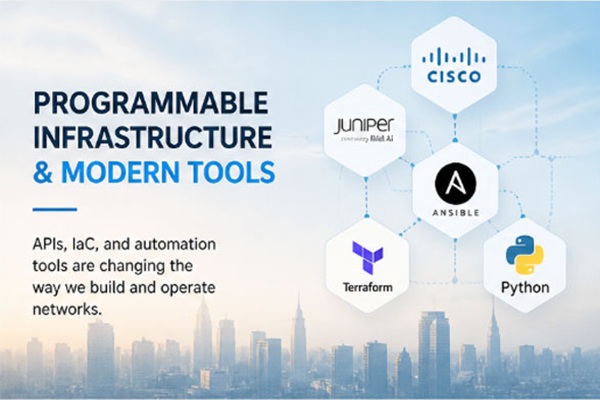
Infrastructure Is Becoming Programmable
One of the biggest changes in modern IT is the concept of programmable infrastructure. Historically, networking and infrastructure management were heavily hardware-centric. Today, APIs, software-defined networking (SDN), and Infrastructure as Code (IaC) are transforming infrastructure into programmable systems. This means networks can now be managed similarly to software applications. Engineers increasingly use:
- APIs
- Python scripting
- YAML/JSON configurations
- Automation frameworks
- Version-controlled infrastructure templates
Popular tools and platforms supporting this transformation include:
- Cisco automation platforms
- Juniper Apstra
- VMware automation solutions
- Ansible
- Terraform
- Python-based frameworks
- Kubernetes ecosystems
These technologies allow organizations to deploy infrastructure faster, maintain consistency across environments, and improve operational visibility.
The Role of Cloud and Kubernetes
Cloud computing has accelerated the demand for automation dramatically. Modern applications are no longer tied to a single physical server or even a single data center. Workloads now operate across:
- Private cloud
- Public cloud
- Hybrid cloud
- Edge infrastructure
At the same time, containerized applications and orchestration platforms such as Kubernetes are becoming standard in modern application deployment. Kubernetes environments are highly dynamic:
- Containers are constantly created and destroyed
- Applications scale automatically
- Traffic patterns change rapidly
- Services communicate across distributed environments
Managing these environments manually is nearly impossible at scale. Automation has therefore become essential for:
- Container networking
- Service discovery
- Load balancing
- Security policy nforcement
- Observability and monitoring
- Application deployment pipelines
This evolution has also contributed to the rise of new operational models such as:
- DevOps
- NetDevOps
Platform Engineering - Site Reliability Engineering (SRE)
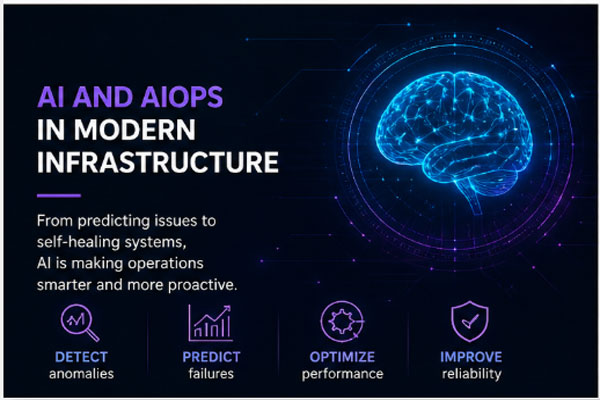
AI Is Changing Infrastructure Operations
The next major evolution in networking is the integration of artificial intelligence into IT operations. This concept is commonly referred to as:
- AIOps (Artificial Intelligence for IT Operations)
AIOps combines:
- Automation
- Machine learning
- Real-time analytics
- Predictive intelligence
to create more intelligent operational environments. Instead of waiting for engineers to detect and respond to problems manually, AI-driven systems can:
- Detect anomalies automatically
- Predict failures before outages occur
- Optimize traffic dynamically
- Correlate events across systems
- Reduce alert fatigue
- Improve operational efficiency
For example, AI-driven platforms may identify unusual latency patterns, bandwidth congestion, or hardware degradation before users experience service disruption. This proactive operational model is becoming increasingly important as infrastructure complexity grows.
Observability and Real-Time Visibility
Modern infrastructure requires more than monitoring alone. Traditional monitoring often focuses on isolated metrics:
- CPU usage
- Memory utilization
- Interface status
However, distributed applications and cloud-native environments require deeper visibility into:
- Network behavior
- Application performance
- Service dependencies
- Real-time telemetry
- User experience
This is where observability becomes critical. Observability platforms help organizations understand:
What is happening
Why it is happening
Where the issue originated
How systems are interconnected
AI-assisted observability is now playing a major role in:
- Root cause analysis
- Performance optimization
- Automated remediation
- Security Automation Is Becoming Essential
As infrastructure becomes more distributed and dynamic, cybersecurity challenges also increase. Manual security operations can no longer respond fast enough to modern threats. Security automation helps organizations:
- Detect threats faster
- Enforce policies consistently
- Automate incident response
- Reduce operational risk
- Improve compliance management
Modern security platforms increasingly integrate:
- AI-based threat detection
- Behavioral analytics
- Automated policy enforcement
- Zero Trust architectures
This convergence between networking, automation, cloud, and security is reshaping the role of infrastructure teams. The role of network and infrastructure engineers is evolving rapidly.
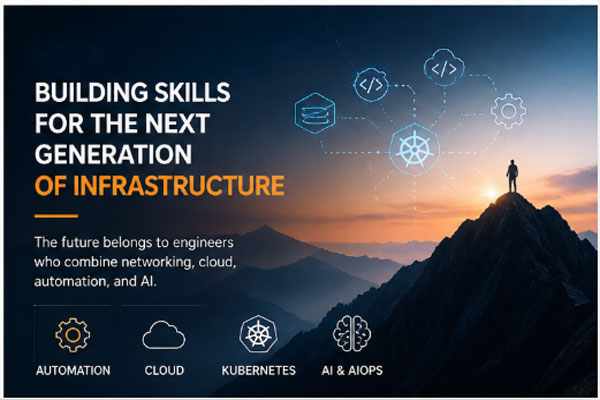
Traditional networking knowledge remains important, but modern engineers are increasingly expected to understand:
- Automation
- APIs
- Python scripting
- Cloud platforms
- Kubernetes
- Infrastructure as Code
- Observability
- AI-assisted operations
This does not mean infrastructure professionals must become software developers. However, understanding programmability and automation is becoming a critical skill for operating modern environments effectively. Engineers who combine networking expertise with cloud and automation knowledge are becoming highly valuable across industries. Automation Is Not Replacing Engineers, It Is Empowering Them. One common misconception is that automation replaces IT professionals. In reality, automation reduces repetitive operational tasks and allows engineers to focus on:
- Architecture
- Optimization
- Innovation
- Security
- Strategic planning
The future of infrastructure is not about removing human expertise, it is about augmenting it with intelligent systems and automation. Organizations that successfully adopt automation and AI-driven operations will be better positioned to:
- Scale efficiently
- Improve reliability
- Reduce operational costs
- Accelerate deployment
- Support future technologies
- Conclusion
Networking is entering a new era. The rise of cloud computing, Kubernetes, AI workloads, and distributed infrastructure is transforming how networks are designed, deployed, and managed. Automation is no longer optional. AI-assisted operations are no longer experimental. Programmable infrastructure is becoming the industry standard. The future of networking will be defined by:
- Intelligent automation
- Real-time observability
- Cloud-native operations
- AI-driven decision making
- Scalable and resilient infrastructure
For engineers and organizations alike, now is the time to embrace automation, develop modern operational skills, and prepare for the next generation of intelligent infrastructure.
Recent Blogs
- The Future of Backup Infrastructure: AI, Autonomous Recovery, and the Evolution of Cyber Resilience
- The Future of Networking: How Automation and AI Are Transforming Modern Infrastructure
- How Cisco AI-RRM Automatically Optimizes Wi-Fi Networks (Complete Guide)
- AWS vs Azure vs GCP – A Practical Comparison of the Top Cloud Providers




FAQ:
Q1: What is network automation?
A1: Network automation is the use of software, scripts, and tools to automatically configure, manage, test, and operate network infrastructure, reducing the need for manual intervention.
Q2: Why is network automation important today?
A2: Because modern infrastructures are highly dynamic (cloud, Kubernetes, AI workloads), manual operations are too slow and error-prone. Automation improves speed, consistency, scalability, and reliability.
Q3: What problems does traditional networking face?
A3: Traditional networking struggles with:Slow deployments
- Human errors
- Limited scalability
- Complex troubleshooting
- Difficulty managing multi-cloud environments
Q4: What is Infrastructure as Code (IaC)?
A4: Infrastructure as Code (IaC) is the practice of managing and provisioning infrastructure using code (like YAML, JSON, or scripts), enabling version control, automation, and consistency.
Q5: Which tools are commonly used for network automation?
A5: Popular tools include:
- Ansible
- Terraform
- Python
- Kubernetes
- Cisco automation platforms
- VMware solutions
- Juniper Apstra
Q6: How does cloud computing increase the need for automation?
A6: Cloud environments are dynamic and distributed. Resources scale up/down constantly, making manual configuration impractical. Automation ensures efficient and consistent management.
Q7: What is AIOps?
A7: AIOps (Artificial Intelligence for IT Operations) uses AI and machine learning to automate and enhance IT operations, including monitoring, anomaly detection, and predictive analytics.
Q8: How does AI improve network operations?
A8: AI helps by:
- Detecting anomalies in real time
- Predicting failures before outages
- Optimizing traffic
- Reducing alert fatigue
- Automating troubleshooting
Let’s Build Your Future Together
Take the Next Step Today
and Explore How Northinex Can Elevate Your IT
with Cutting-Edge Technology Tailored for Your Business
Companies We Are Work With